
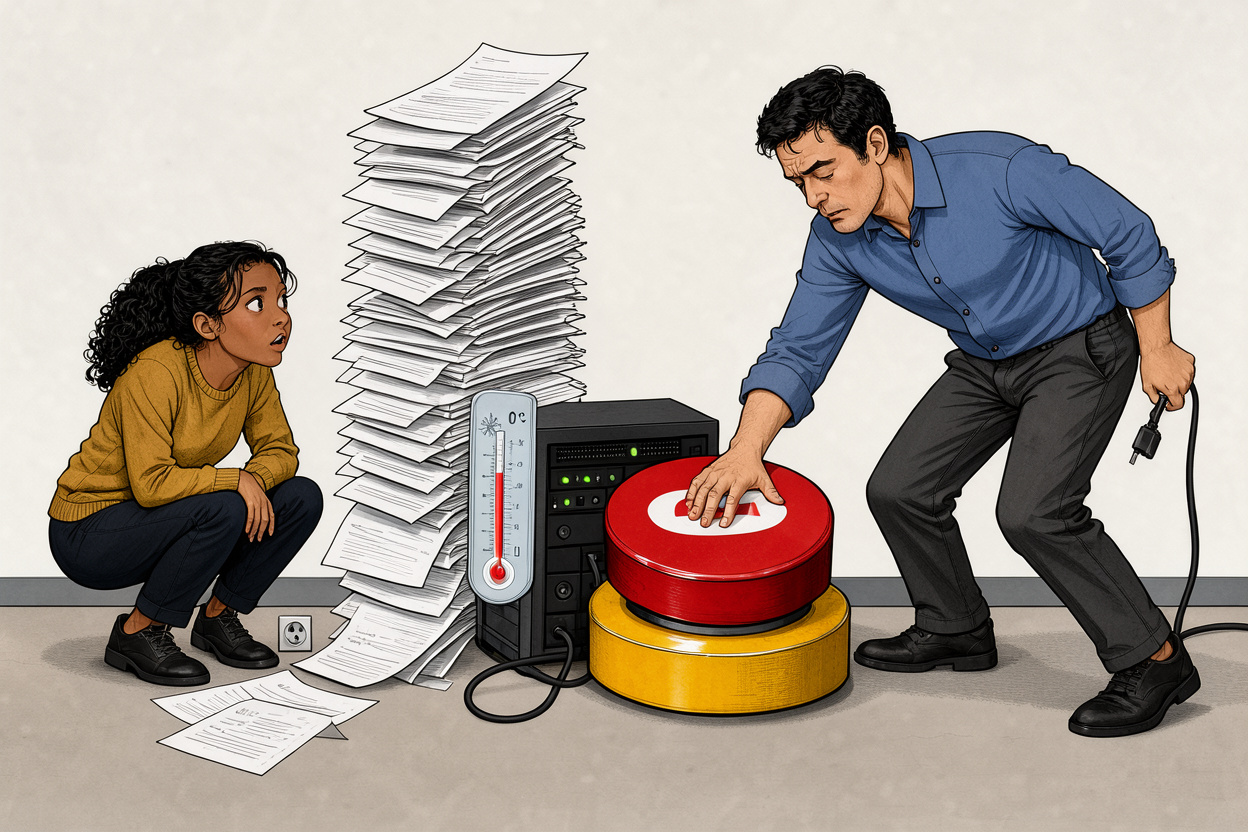
The recent internal audit of OmniCorp’s Tertiary Server Division focused on the mandated Zero-Utilization Infrastructure (ZUI). The review centered on the operational efficiency of a legacy database that had registered zero external calls over the previous fiscal year. The auditors, led by Senior Compliance Officer Quinn, noted the unprecedented energy load.
A mandatory 'Active State Compliance Log' must be maintained for the ZUI. This log is the only legally recognized documentation of the system’s controlled deactivation status. The system’s continuous, non-functional operation generates an estimated 4.2kW load, exceeding the allocated power budget for the entire server wing.
To comply, Operations Manager Ms. Elara Vance implemented a 'Zero-Utilization Validation Check.' This protocol requires a quarterly, physically monitored log entry to verify the ambient thermal stability of the dormant hardware chassis. This procedure, intended to verify safety, has resulted in significant new bureaucratic overhead.
The audit team observed this specific requirement on site. They noted the installation of a specialized environmental monitoring unit, which must physically touch the server rack while running at peak efficiency. Ms. Vance defended the process, stating, 'If it is not logging its own stable temperature, how can we prove it is accurately dormant?'
The report detailed Discovery Two: the cost of maintaining the compliance documentation. It was found that the administrative labor and energy required to generate the 'Proof of Non-Activity' exceeded the total energy consumption of the database itself. This established a negative operational ROI.
Discovery Three emerged during the quarterly check. Junior Engineer Kip filed a supplemental incident report stating that the validation unit's power consumption was temporarily spiked when a designated QA Technician manually verified the chassis temperature against a non-connected thermocouple. The technician's log noted the spike as 'Human Data Interaction Event 401-B.'
This led to Discovery Four, as the audit framework mandates that all 'Human Data Interaction Events' must be logged, categorized, and subsequently justified. Mr. Finch, Head of Audit, was found filling out a triplicate form to certify that the validation unit’s spike was 'Unintentional Data Calibration Overhead' rather than an actual power drain event.
Management reviewed the technical findings, including the thermodynamic instability caused by the compliance reporting. They were advised that decommissioning the ZUI would void the legal declaration that the system was 'In Compliant Dormancy.' The system’s perpetual idling became a point of legal liability.
The final discovery, documented in Addendum C, confirmed that the entire ZUI infrastructure was running on a redundant power supply that was itself powered by a self-monitoring generator. When asked why the generator was active, the ZUI administrator replied, 'The generator’s standby consumption is legally required to be verified as 'Available Capacity,' and we lack the energy budget to verify it'
travel mode.'