
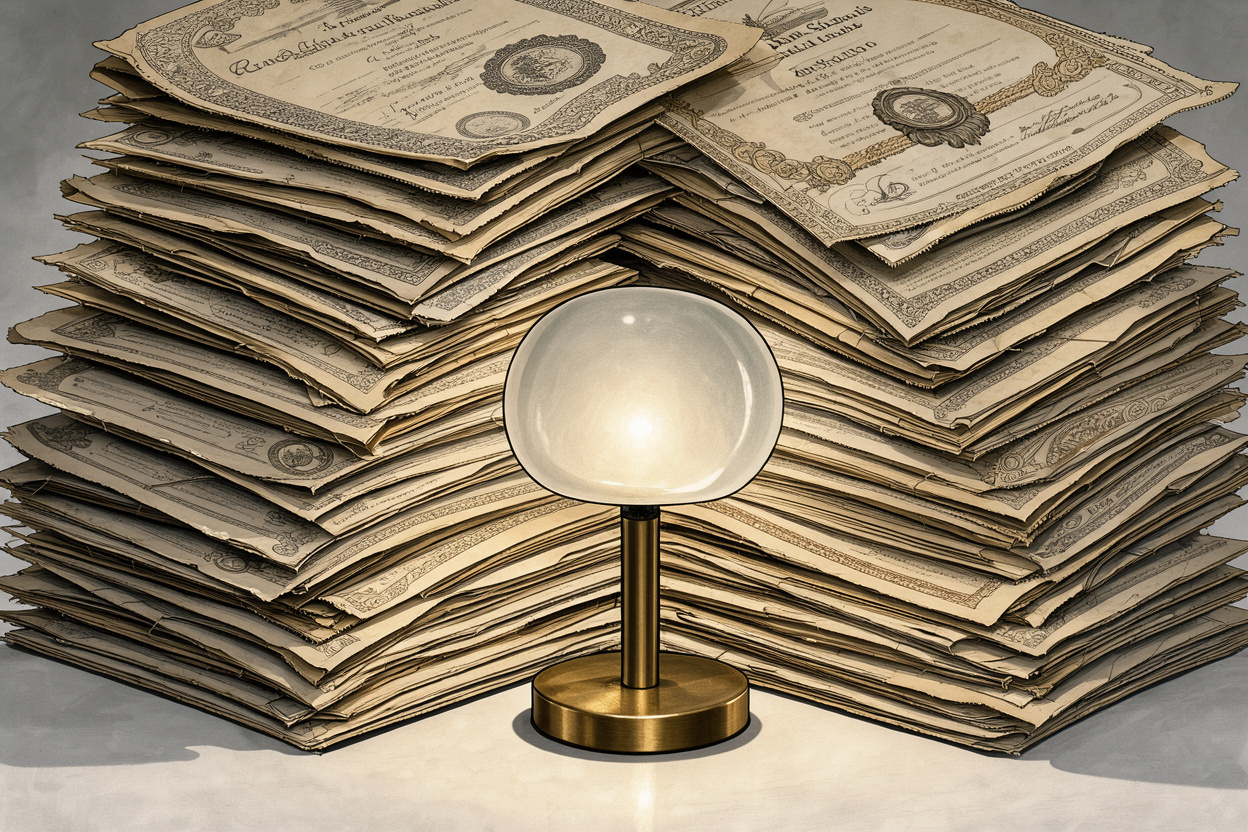
On Thursday, Bree Dalgleish paid $2,200 to authenticate a lamp she had purchased new the previous Tuesday. The lamp had functioned perfectly all week. What it lacked, she explained, was a past, and a lamp without a past is merely lighting, while a lamp with paperwork is an heirloom. The object did not change. The font on its certificate did.
"I couldn't serve dinner under a retail lamp," Dalgleish said, gesturing at the invoice, which she had framed before framing the lamp. "Guests can tell. They can't tell what, but they can tell." She had chosen the certificate in Aged Charter Serif, a typeface designed to look older than the building where it is printed.
The appraiser, Holt Fenwick of Fenwick & Fenwick & One More Fenwick, issued the certification with visible pride. He confirmed the lamp's condition as "pristine," then revised the word to "unspoiled by history," a phrase that raised the appraised value from $180 to $4,100 without anyone touching the lamp. Value, Fenwick explained, flows backward through the paperwork, like sap.
There was one obstacle: the dinner party was Saturday, and eleven decades of heritage take longer to accumulate naturally. Fenwick offered his patented Accelerated Patina Service, which ages the lamp in a humidity chamber over a single weekend. The lamp entered the chamber as a Tuesday purchase and emerged Sunday as a survivor of three world wars it had never attended.
"We don't fake age," Fenwick said, adjusting a dial labeled SOOT. "We compress it. Your grandmother's dust and our dust are chemically identical, and ours arrives on schedule." He charged an additional $600 for the wars, which the lamp had now, on paper, outlived.
The provenance papers traced the lamp to a great-grandmother Dalgleish had not known she had, and so she invented one in fuller detail: Seraphina Dalgleish of a coastal town, widowed young, partial to amber glass. Within days, two actual relatives surfaced with photographs of their own grandmother, who had owned, they claimed, a very similar lamp, or possibly this one.
The relatives retained a lawyer, Duvall Grimsby, who bills by the supposition. His opening invoice included fourteen hours for "ancestral reconnaissance," six hours for "emotional inheritance mapping," and one itemized line reading "feels about the lamp," at his standard rate.
To settle the dispute, Dalgleish commissioned a second, even older-looking lamp as a comparison sample. The conservator examined both for a week and certified the original as a recent replica of the replica. This finding, by Fenwick's own formula, made both lamps more expensive, since a documented fraud is still documentation, and therefore heritage.
The replica of the replica is now listed at $9,300, pending its second certificate, which certifies the first certificate. I confess the rest: I ordered the replica of the replica Tuesday, pre-ordered its certificate, and laminated my receipt, which now appraises, in this market, higher than I do.
"Heritage," Fenwick told me while stamping my invoice with a seal older than his firm's oldest lamp, "is simply proof of purchase with better lighting." My certificate arrives Friday. My lamp, he assured me, will arrive eventually, once the chamber finishes inventing my childhood.